The Sand Horse by Mimmo Paladino: a contemporary icon among the temples of Paestum
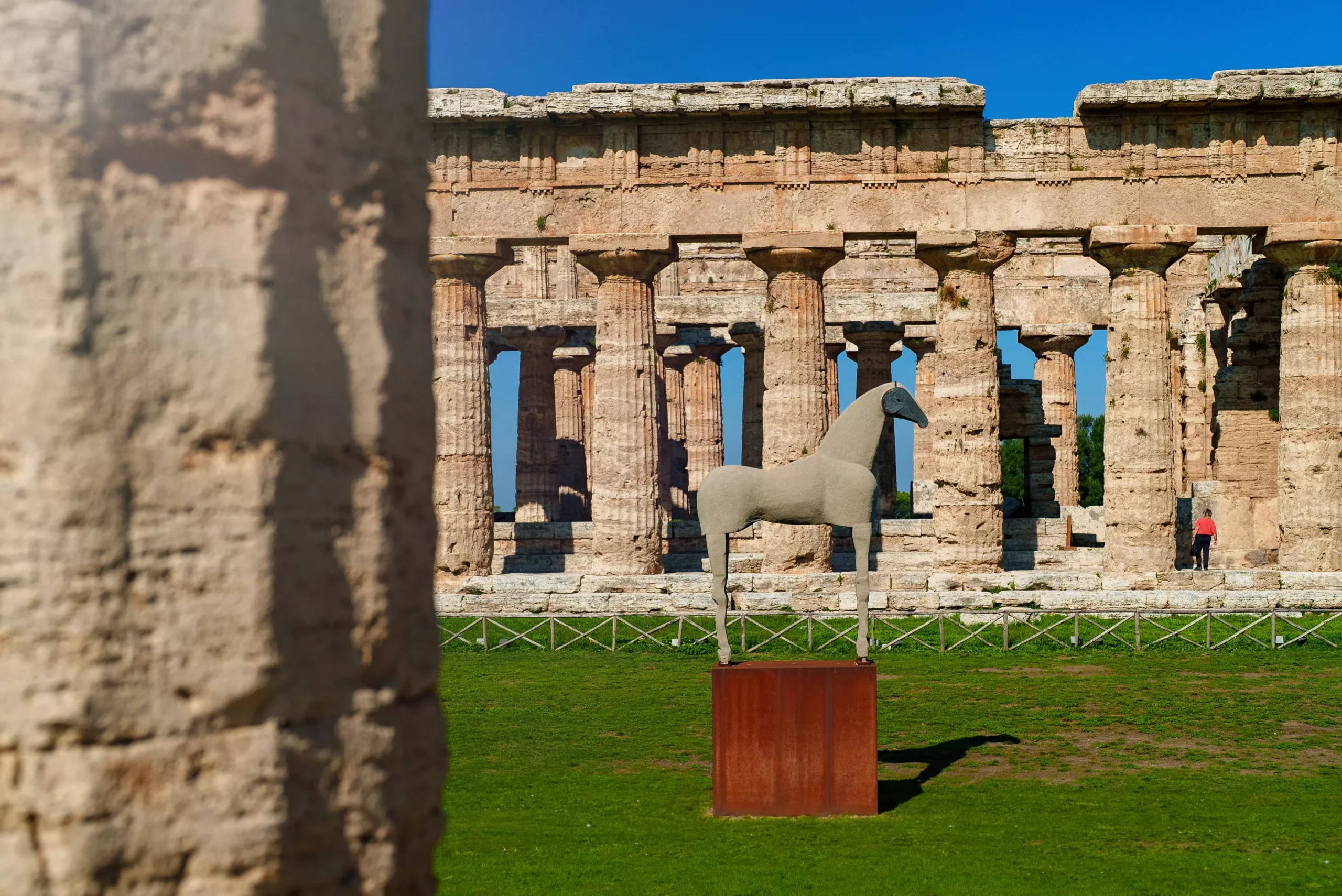
mong the Doric temples of Paestum, a mark of contemporaneity also emerges: The Sand Horse by Mimmo Paladino.
While in other major Italian archaeological sites—such as the Archaeological Park of Pompeii or the Archaeological Park of the Valley of the Temples—the dialogue between archaeology and contemporary art has been entrusted to the neoclassical works of Igor Mitoraj, in Paestum this comparison takes place through Paladino’s archaic and symbolic language, which merges with the Doric architectures of the 6th and 5th centuries BCE.
The Sand Horse, created in 1999, is the first of the artist’s celebrated series of horses, described by Paladino himself, with irony, as the “father of the herd.” The work was originally conceived for the MMMAC – Museum of Minimal Materials in Contemporary Art, directed by Nuvola Lista. After being exhibited for several years near the archaeological area of Paestum, the sculpture was moved to Fisciano, in the province of Salerno, following the events that affected the museum. In 2019, an agreement between the Archaeological Park of Paestum and Velia—then directed by archaeologist Gabriel Zuchtriegel—and the MMMAC made it possible to return the work to the place for which it had originally been conceived.
The sculpture, approximately four meters high, is made with sand from the beach of Paestum, an element that reinforces its material and symbolic connection to the territory. The horse wears an iron mask that recalls Lucanian-period tombs and is placed on a pedestal between the Temple of Neptune and the Temple of Hera, also known as the Basilica. In this setting, the work introduces an almost theatrical dimension into the monumental space of the temples, establishing a visual dialogue between the evocative power of contemporary sculpture and the monumentality of ancient architecture. With this installation, Paestum confirms itself as one of the Italian archaeological sites most attentive to the dialogue between archaeology and contemporary art, experimenting with new ways of interpreting and inhabiting the ancient landscape.
I Parchi archeologici di Paestum e Velia sono un istituto del Ministero della Cultura dotato di autonomia speciale, iscritto dal 1998 nella lista del patrimonio mondiale UNESCO.
The Archaeological Parks of Paestum and Velia; an institute of the Ministry of Culture, with special autonomy and listed as a UNESCO World Heritage Site since 1998.